
Welcome to our study of the New Testament book of Hebrews! If you’re a relatively new believer, you may not be very familiar with this book. And even if you’re a seasoned Christian that has a solid grounding in Scripture, there’s a good likelihood that you may not have spent much time with Hebrews or heard many messages preached or podcasts created that focus on it. You may have even heard that it’s a “hard book to understand” or that is has “lots of deep doctrine” and “obscure references to the Old Testament”.
Admittedly there are parts of Hebrews that will definitely challenge us. But my encouragement to you is that you lean in to our study and read this, not as a dry textbook that you’re trying to memorize the key facts for a final exam, but rather as a passionate exhortation from a pastor to his flock, encouraging them to hold fast to the faith that they received. So, let’s dive in!
Going back to what most of us learned in elementary school, we should start by trying to answer some “W” questions:
- Who was the author of Hebrews?
- Who was the intended audience?
- When was Hebrews written?
- What is Hebrews about?
- Why was Hebrews written?
- Why is Hebrews in our New Testament, anyway?
To try and answer some of these questions above, let’s read the very beginning and end of the book and see if we can get some clues. If you’re feeling ambitious, have a quick scan through the entire book and see if you pick up any other hints.
From Chapter 1:
Long ago God spoke many times and in many ways to our ancestors through the prophets. And now in these final days, he has spoken to us through his Son. God promised everything to the Son as an inheritance, and through the Son he created the universe. The Son radiates God’s own glory and expresses the very character of God, and he sustains everything by the mighty power of his command. When he had cleansed us from our sins, he sat down in the place of honor at the right hand of the majestic God in heaven. This shows that the Son is far greater than the angels, just as the name God gave him is greater than their names.
From Chapter 13:
Keep on loving each other as brothers and sisters. Don’t forget to show hospitality to strangers, for some who have done this have entertained angels without realizing it! Remember those in prison, as if you were there yourself. Remember also those being mistreated, as if you felt their pain in your own bodies.
Give honor to marriage, and remain faithful to one another in marriage. God will surely judge people who are immoral and those who commit adultery.
Don’t love money; be satisfied with what you have.

Remember your leaders who taught you the word of God. Think of all the good that has come from their lives, and follow the example of their faith.

Jesus Christ is the same yesterday, today, and forever. So do not be attracted by strange, new ideas. Your strength comes from God’s grace, not from rules about food, which don’t help those who follow them.

We have an altar from which the priests in the Tabernacle have no right to eat. Under the old system, the high priest brought the blood of animals into the Holy Place as a sacrifice for sin, and the bodies of the animals were burned outside the camp. So also Jesus suffered and died outside the city gates to make his people holy by means of his own blood. So let us go out to him, outside the camp, and bear the disgrace he bore. For this world is not our permanent home; we are looking forward to a home yet to come.

Therefore, let us offer through Jesus a continual sacrifice of praise to God, proclaiming our allegiance to his name. And don’t forget to do good and to share with those in need. These are the sacrifices that please God.

Obey your spiritual leaders, and do what they say. Their work is to watch over your souls, and they are accountable to God. Give them reason to do this with joy and not with sorrow. That would certainly not be for your benefit.

Pray for us, for our conscience is clear and we want to live honorably in everything we do. And especially pray that I will be able to come back to you soon.

I urge you, dear brothers and sisters, to pay attention to what I have written in this brief exhortation.
I want you to know that our brother Timothy has been released from jail. If he comes here soon, I will bring him with me to see you.
Greet all your leaders and all the believers there. The believers from Italy send you their greetings.
May God’s grace be with you all.
So, with the above in mind, let’s try to answer a few of the questions (if we can!):
- Who was the author of Hebrews?
- Who was the intended audience?
- When was Hebrews written?
- What is Hebrews about?
- Why was Hebrews written?
- Why is Hebrews in our New Testament, anyway?
Hebrews is a notoriously difficult book to try and outline. It’s not a history, so trying to outline it chronologically isn’t going to help. It’s not like some of the other letters of the New Testament, where it’s clear that the note is a response to a question or to an issue that the church was needing clarification or correction. And it’s not a revelation (apocalypse) with lots of symbolic language and prophesy.
I’m going to suggest that the best way to understand Hebrews is like a sermon. It has a central topic (can you guess?), lots of connections back to the Old Testament scriptures (which the audience would likely have been familiar with), and loads of applications that the audience can put into practice.
Here’s a suggested outline that you can follow along with as we go through this study:
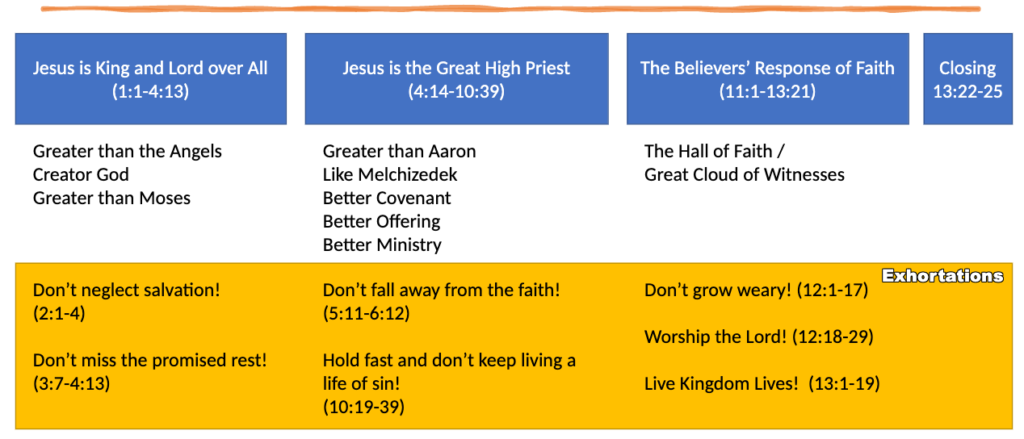
- What is the central theme of the book?
- What do you think the audience may have been needing to hear?
- What questions do you have?